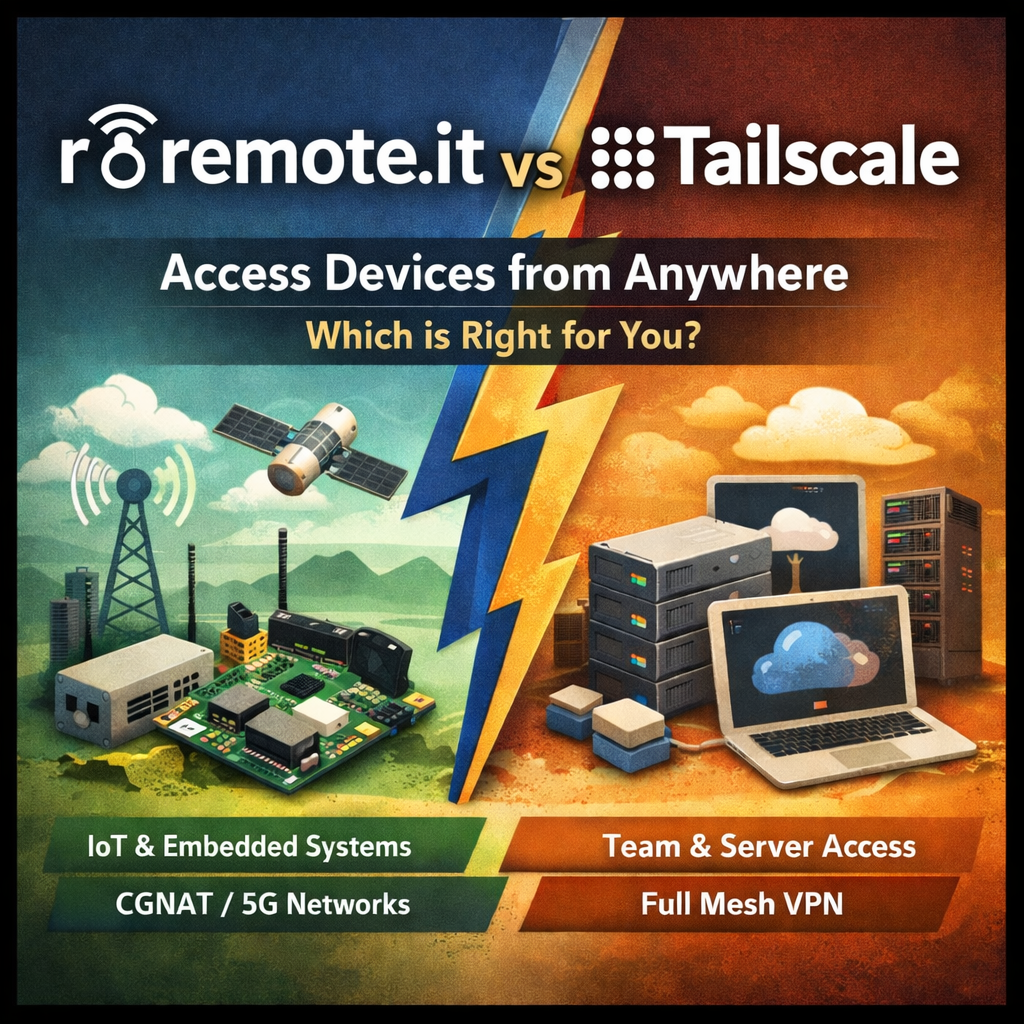
Both tools let you access devices from anywhere. Choose the right one for your use case.
The short answer
Tailscale is a mesh VPN built for team access to shared infrastructure. Remote.it is purpose-built for connecting to individual devices — especially IoT hardware, embedded systems, and anything running on a cellular or satellite network with no public IP.
If you are connecting a team of people to a shared server, Tailscale works well. If you are deploying a fleet of edge devices, managing IoT hardware at scale, or shipping remote access as a capability inside a physical product, remote.it handles the exact problems Tailscale was not designed for.
When to use remote.it
- Your devices are on 5G, Starlink, or other CGNAT networks with no public IP.
- You are building or shipping IoT hardware and need remote access baked into the product.
- You need per-service, least-privilege access — not subnet-level or device-level access.
- You want zero open ports and zero inbound firewall rules on your hardware.
- You are managing a fleet of devices where installing a full VPN client on each one is not practical.
- You need setup to happen in a single shell command or via API during manufacturing.
When Tailscale is a better fit
- You are connecting a team of people to shared cloud or on-prem servers.
- All your devices run a mainstream OS where installing the Tailscale client is trivial.
- You want a mesh network where all devices see each other directly.
- You do not need IoT-scale device management or embedded hardware support.
Feature comparison
| Feature | remote.it | Tailscale |
|---|---|---|
| Works behind CGNAT / 5G / Starlink | Yes — core use case | Yes, but peer-to-peer relay required; not optimized for large IoT fleets |
| No open ports required | Yes — zero inbound ports | Yes — WireGuard uses outbound UDP |
| Setup complexity | One line of shell code or API call | Requires client install and account auth on each device |
| Per-service access control | Yes — grant access to a specific port or service only | No — access is at the device or network level |
| IoT / embedded hardware support | Yes — ARM, MIPS, lightweight agent | Limited — client is heavier; not designed for constrained hardware |
| OEM / manufacturing deployment | Yes — API-driven registration at factory | Not designed for this use case |
| Free tier | Yes — personal plan, unlimited devices | Yes — up to 100 devices, 3 users |
| Pricing model | Per device | Per user |
| Full mesh VPN (all devices see each other) | No — point-to-point service connections | Yes — full mesh tailnet |
| Team remote access to shared servers | Yes, but not the primary use case | Yes — purpose-built for this |
| SSO / SAML | Yes (Business plan) | Yes (Premium plan, $18/user/month) |
| Audit logging | Yes (Business plan) | Yes (Premium plan) |
| API for device management | Yes — full REST API | Yes — Tailscale API |
The key difference: pricing model
Tailscale charges per user. Remote.it charges per device. If you have 500 IoT devices accessed by 3 engineers, Tailscale charges for 3 users. But its model does not scale to device fleets the way remote.it does — Tailscale’s free tier caps at 100 devices, and per-user pricing makes less sense when devices outnumber people by 100x.
Pricing at a glance
| Tier | remote.it | Tailscale |
|---|---|---|
| Free | Personal plan — unlimited devices, 5 connections | 3 users, 100 devices |
| Team / Paid | Professional — per device pricing | Starter: $6/user/month — Premium: $18/user/month |
| Enterprise | Custom — volume device licensing | Custom — SSO, audit, advanced ACLs |
| Best for | Device-centric fleets, IoT, OEM hardware | User-centric team access, shared infrastructure |
Frequently asked questions
Can remote.it replace Tailscale for team access?
Yes, for most use cases. Remote.it gives granular per-service access to any device, which is more secure than Tailscale’s subnet-level access. For teams that primarily need to SSH or RDP into specific machines, remote.it is a direct replacement.
Does remote.it work on Raspberry Pi?
Yes. Remote.it has native support for Raspberry Pi and is one of the most popular tools in the Raspberry Pi community for remote access. Setup takes under 5 minutes.
Does Tailscale work on embedded Linux or custom hardware?
Tailscale has ARM binaries, but it is a heavier client with more dependencies than remote.it’s agent. For constrained hardware or devices where you control the OS image at manufacturing time, remote.it’s single-binary agent is simpler to integrate.
Which is better for a startup building IoT hardware?
Remote.it. It has direct support for OEM device registration, API-driven provisioning, and a pricing model that scales with device count rather than user count. Tailscale was designed for connecting a team of people, not for shipping access as a capability embedded in a product.
What happens if my device is behind a CGNAT or has no static IP?
Remote.it was built specifically for this. It works on 5G, Starlink, and any CGNAT network where there is no public IP and no port forwarding available. Tailscale can work in these environments but uses relay infrastructure not optimized for large device fleets.
Try remote.it free — setup in 60 seconds, no credit card required.
Start your free account at https://app.remote.it/#/sign-up
Free personal plan includes unlimited devices.